

Security
Security is a core part of how Lucid is designed, deployed, and operated. In addition to third-party smart contract audits, Lucid follows a defense-in-depth approach across contract governance, operational security, and production infrastructure.
Smart Contract Audits
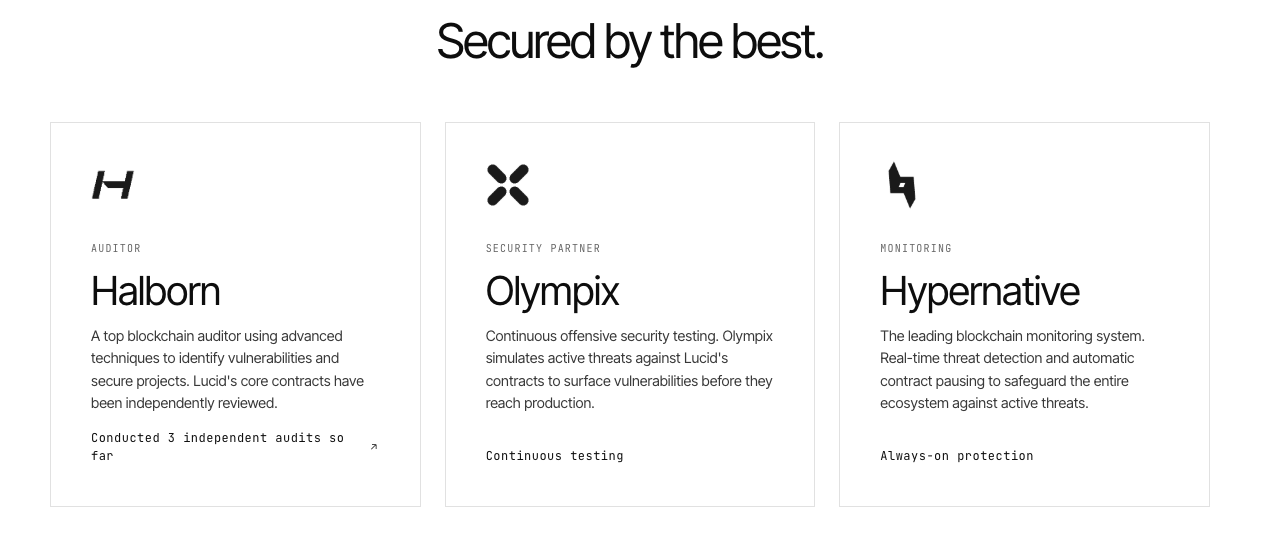
Lucid has undergone multiple independent smart contract security audits from auditors like Halborn and Hashlock. You can find previous audit reports below:
| Auditor | Date | Download Link |
|---|---|---|
| Halborn | April 2025 | View full report |
| Halborn | June 2025 | View full report |
| Halborn | October 2025 | View full report |
| Hashlock | May 2026 | View full report |
Real-Time Monitoring
In addition to external audits, Lucid uses Hypernative for real-time security monitoring. This gives us additional visibility into onchain activity and helps us detect and respond to unusual behavior, emerging threats, and operational anomalies as quickly as possible.
Real-time monitoring is an important part of our broader security model, helping us complement preventative controls with active oversight in production.
Continuous Security Review
Lucid also uses Olympix as part of its security workflow. Olympix provides an additional layer of continuous security review and helps strengthen our development and deployment processes with ongoing security-focused analysis.
Together with external audits and operational controls, this helps us maintain a stronger ongoing security posture rather than relying only on point-in-time reviews.
Operational Security
The Lucid bridge is operated as a managed service, with security controls that extend beyond audited code alone. We apply operational safeguards around privileged access, production systems, and ongoing infrastructure management to help ensure the bridge remains reliable and secure in practice.
Our operational security approach includes:
- Sensitive contract and administrative access is managed through a multisig.
- Signers use dedicated hardware wallets to reduce the risk of key compromise.
- Privileged actions are limited to a small set of authorized operators under controlled internal processes.
- Critical changes are handled with review, coordination, and operational oversight.
- Security is treated as an ongoing practice across maintenance, monitoring, and incident readiness.
These measures are designed to reduce single points of failure, strengthen operational resilience, and provide users and partners with additional assurance around how Lucid is run in production.
Our Approach
No system can claim absolute risk elimination, but Lucid is built and operated with security as a continuous priority. By combining external smart contract audits, real-time monitoring with Hypernative, and Olympix for continuous pre-deployment testing with strong operational controls and managed production oversight, we aim to provide robust and trustworthy bridge infrastructure.
As Lucid expands to support new partners, new chains, and new deployment requirements, we are also able to evolve the operational setup accordingly. This includes working closely with ecosystem partners on tailored deployment and security models that fit their needs while maintaining a strong security baseline.
Bug Bounty
We also support responsible security disclosure through our bug bounty program. If you believe you have identified a vulnerability, please refer to our bug bounty page for details on scope, reporting guidelines, and the disclosure process.
For more information, see: Bug Bounty