

Organisations Overview
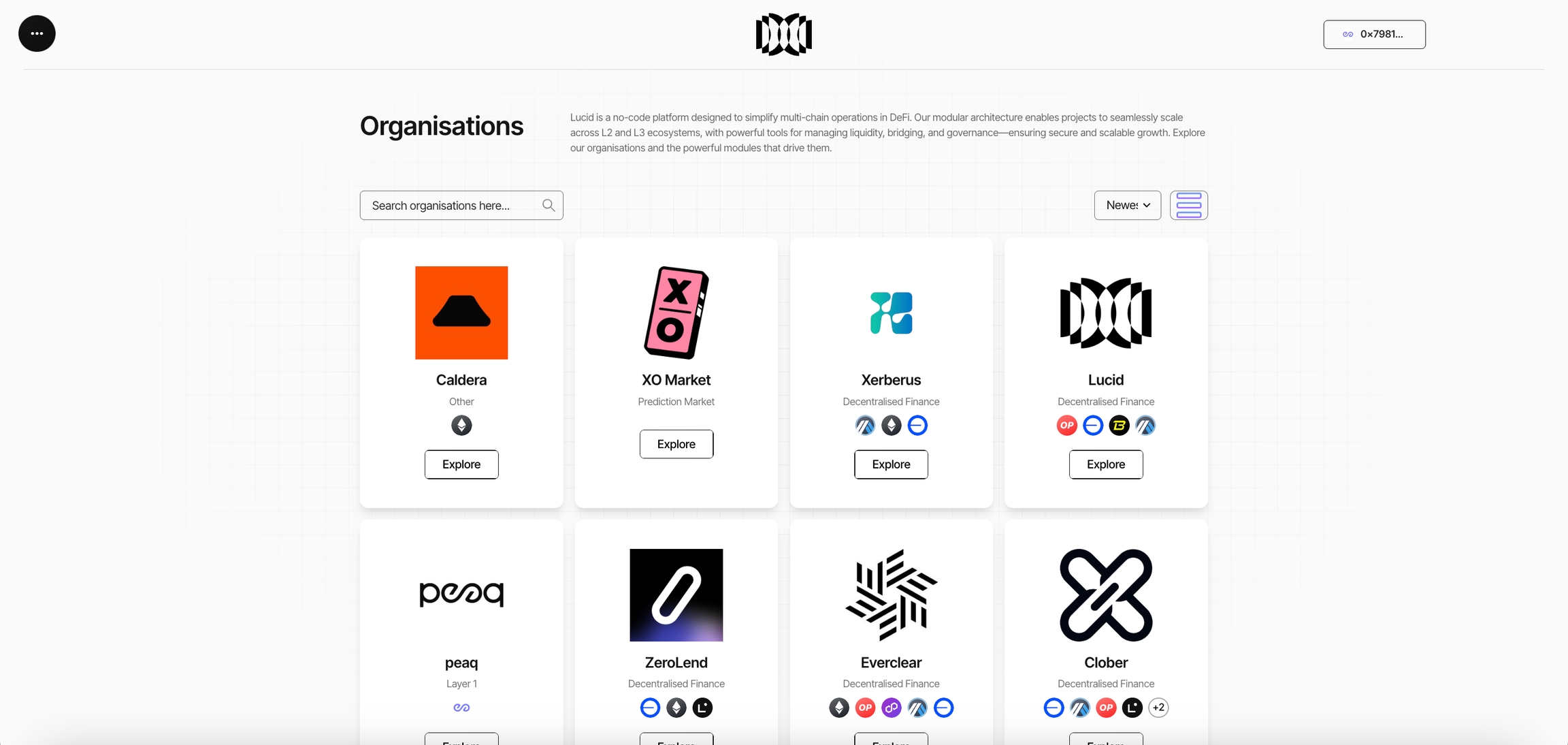
Organisations are Lucid’s modular ecosystem management environments for coordinating governance, interoperability, liquidity infrastructure, treasury operations, and protocol management.
Each organisation acts as an operational layer where ecosystems can deploy and manage infrastructure modules directly through Lucid.
Organisations allow ecosystems to:
- manage cross-chain infrastructure
- coordinate governance systems
- deploy OTC settlement and vesting infrastructure
- manage treasury operations
- configure interoperability infrastructure
- coordinate protocol upgrades
- manage token infrastructure
- operate modular ecosystem tooling through one environment
Organisation Infrastructure
Each organisation can deploy and manage modular infrastructure depending on operational requirements.
Infrastructure is coordinated through configurable modules connected directly to the organisation environment.
This allows ecosystems to:
- enable only required infrastructure
- coordinate operational permissions
- manage deployments across multiple chains
- maintain modular governance and interoperability architecture
Supported Modules
Organisations support multiple infrastructure modules across governance, interoperability, treasury, and liquidity coordination.
Supported module categories include:
| Category | Purpose |
|---|---|
| Interoperability | Cross-chain messaging, bridge coordination, and transfer infrastructure |
| Governance | Voting systems, veto infrastructure, and proposal coordination |
| Liquidity Management | Treasury operations, OTC deal infrastructure, and liquidity coordination |
| Collaboration | Operational management and working group coordination |
| Protocol Management | Upgrade infrastructure and protocol administration |
Additional module configuration and deployment flows are covered in the Creating an Organisation section.
Organisation Dashboard
Each organisation includes a dedicated management dashboard for monitoring infrastructure, configurations, modules, and operational activity.
The dashboard provides:
- organisation profile information
- supported chains
- deployed modules
- operational management access
- governance interfaces
- analytics access
- contract address visibility
- infrastructure configuration controls
Operational flows vary depending on the modules enabled within the organisation.
Module Management
Each deployed module includes its own operational management interface.
Management interfaces can support:
- analytics
- proposal management
- operational approvals
- infrastructure configuration
- governance coordination
- treasury management
- interoperability administration
Some modules may redirect to integrated external infrastructure providers depending on the configured ecosystem architecture.
Supported Chains
Organisations can deploy infrastructure across multiple supported chains simultaneously.
Supported chains are displayed directly within the organisation dashboard and determine where:
- governance infrastructure operates
- interoperability modules are deployed
- token infrastructure is configured
- treasury systems are managed
Multi-chain deployment support depends on the selected modules and infrastructure configuration.
Contract Infrastructure
Each organisation maintains visibility into deployed smart contract infrastructure across supported chains.
The dashboard includes:
- module contract addresses
- deployment visibility
- chain-specific infrastructure references
- explorer integrations
This allows ecosystems to review deployed infrastructure and monitor operational activity directly through connected block explorers.
Modular Architecture
Lucid’s organisation infrastructure is designed around modular deployment architecture.
This allows ecosystems to:
- deploy infrastructure incrementally
- separate governance and operational responsibilities
- configure interoperability independently
- coordinate treasury and liquidity infrastructure modularly
- scale ecosystem infrastructure over time
Additional deployment, governance, and interoperability configuration flows are covered in the following sections.